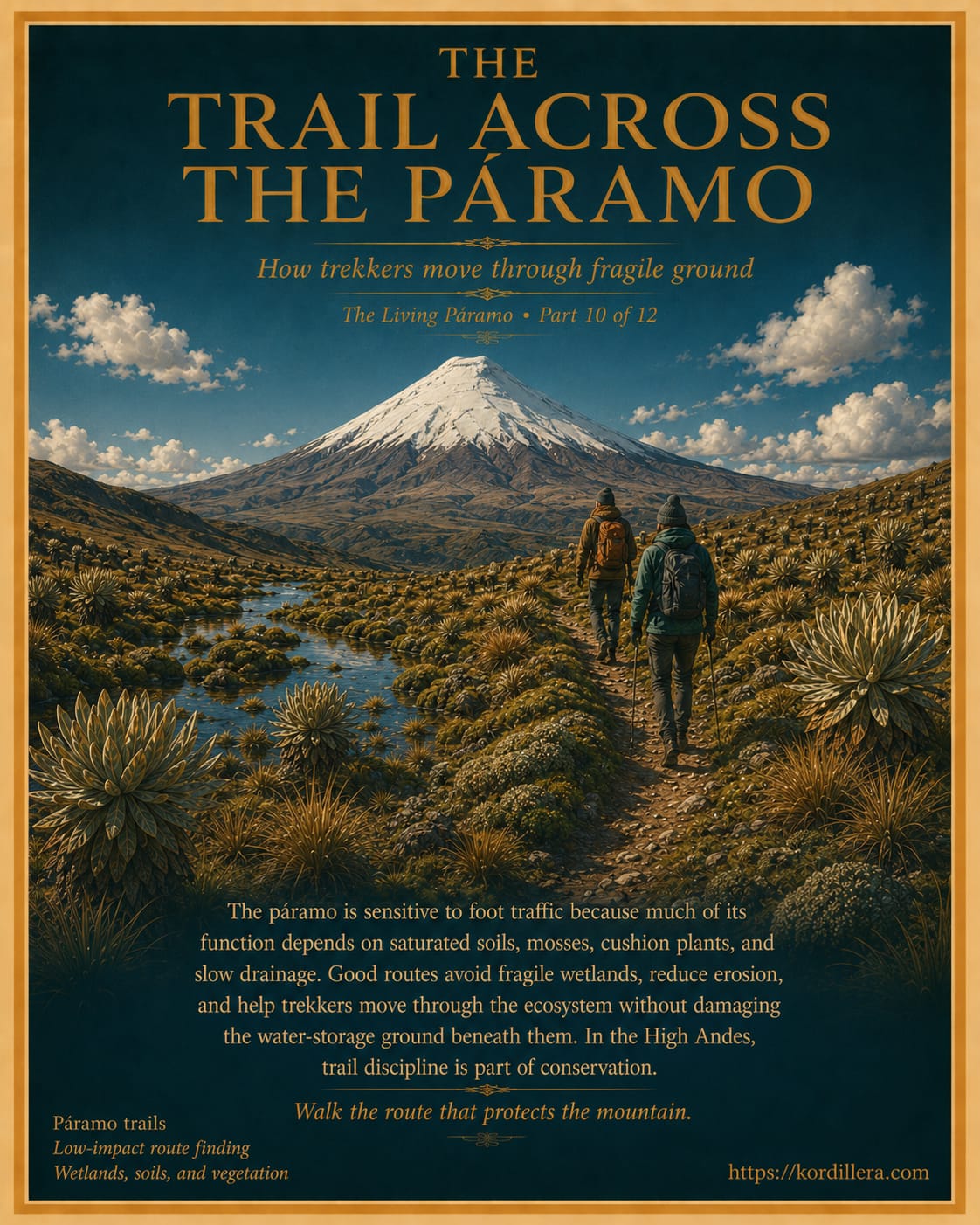
Part 10 of 12 in The Living Páramo series.
In the High Andes, the ground under our feet is often the most overlooked piece of the expedition. We obsess over the summit, the ridgeline, or the vista ahead, but in the páramo, the trail is far more than just a path across open ground. It is a way of moving through one of the most sensitive, complex ecosystems on the planet.
Welcome to Part 10 of our Living Páramo series. Today, we focus on the art and ethics of moving through the high country.
A System, Not Just Scenery
To the uninitiated, the páramo may look like an undifferentiated expanse of grassland—a place to simply walk from Point A to Point B. But the reality is a living, hydrological system.
The páramo stores water in saturated soils, mosses, cushion plants, wetlands, and slow-draining ground. This water is the lifeblood of the valleys below. When we step off-trail, or when poor route choices are made, the impact is immediate and lasting:
- Vegetation Damage: Alpine plants in the páramo are slow-growing and adapted to specific, often harsh conditions. They do not recover from foot traffic as resiliently as lowland grasses.
- Erosion: Once the protective cover is broken, the delicate soil is susceptible to water runoff, widening trails and creating scars on the landscape that can persist for decades.
- Hydrological Disruption: Disturbed wetlands and compacted soil paths can alter the flow of water, weakening the very sponge-like capacity that makes the páramo a vital water tower for the Andes.
The Kordillera Philosophy: Trekking with Intent
At Kordillera, we believe that an expedition does not begin at the base of the peak. It begins with the first step on the trail.
We treat the approach not as empty terrain to be traversed, but as an integral part of the mountain experience. On a well-guided route, the trek is an education. Our guests learn to read the ground: they learn to identify where water is held, where plant communities are fragile, where a path protects the ecosystem, and, crucially, where the mountain should simply be left alone.
Moving Through the Living Landscape
The reward for this mindful approach is not only reaching a summit or a viewpoint. It is the deeper satisfaction of understanding the living landscape under your boots.
When you learn to move through the páramo with respect, you change your relationship with the mountains. You stop being a visitor who merely “crosses” the terrain and become a participant who protects it.
Walk the route that protects the mountain. Join us as we explore the High Andes with knowledge, care, and absolute confidence.