The Living Barrage
Part 12 of 12 in The Living Páramo Series
Mountains are born through tectonic forces, but they are sculpted by erosion.
As Earth’s crust pushes upward, gravity, water, wind, frost, and time begin the equally powerful work of wearing mountains down. The Andes exist because these opposing forces never stop interacting. One builds. The other reshapes.
The páramo exists at the center of that balance.
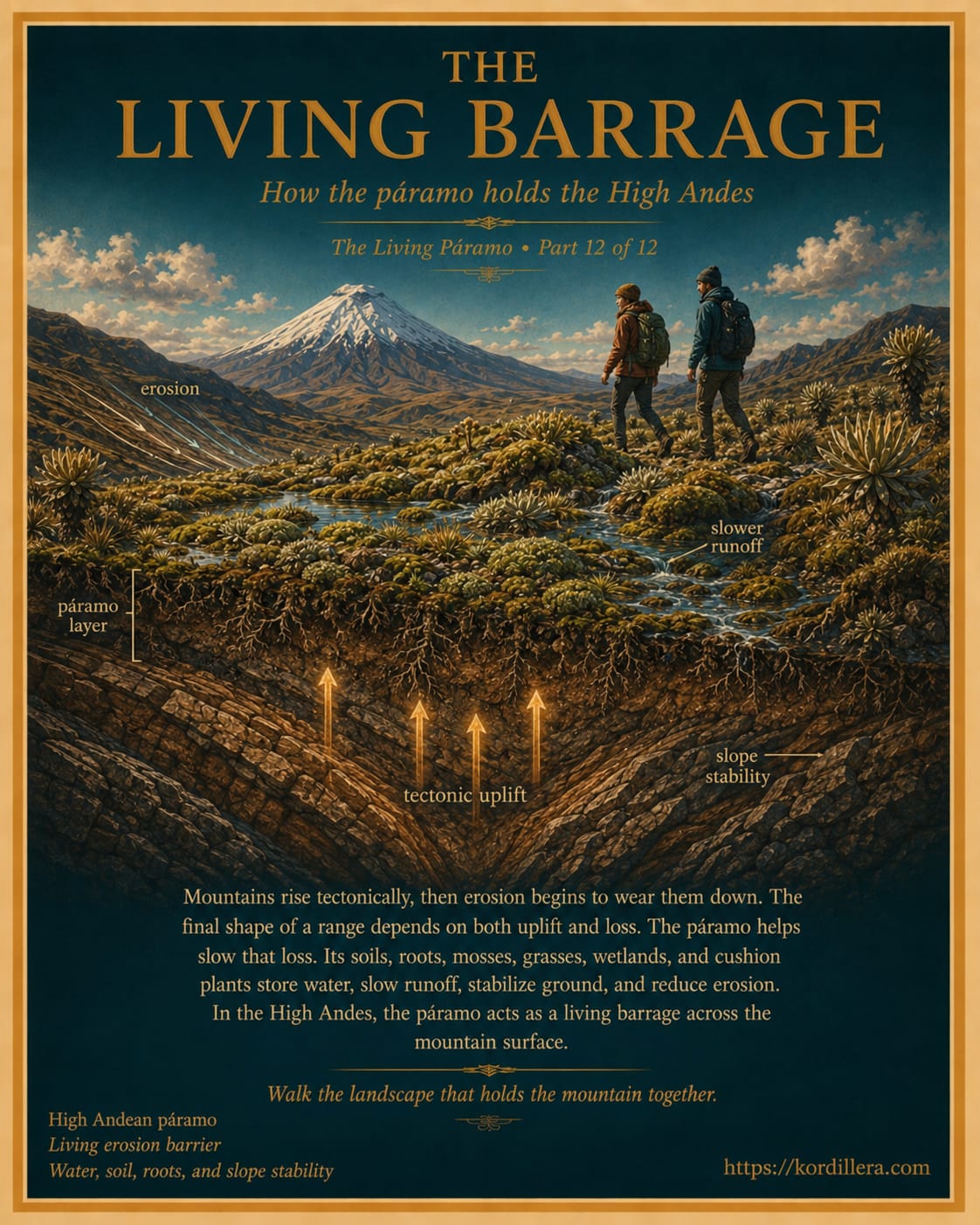
Far more than a beautiful alpine landscape, the páramo functions as a living system that regulates how the high mountain behaves. Its dense network of roots, organic soils, mosses, grasses, wetlands, and cushion plants captures rainfall and cloud moisture, stores it like a sponge, and releases it gradually into streams and rivers below.
At the same time, these living communities anchor fragile soils, reduce erosion, stabilize steep slopes, and store enormous quantities of carbon. Although the páramo does not create the Andes geologically, it plays an essential role in preserving the mountain surface that tectonic forces have raised.
A Living Barrage
The comparison to a dam is surprisingly accurate.
Unlike a concrete structure built by engineers, the páramo forms a living barrage—a vast biological network spread across the high Andes. Every patch of moss, every cushion plant, every wetland, every grass tussock, and every root system works together to slow water, trap sediment, and hold the landscape together.
When trekkers cross the páramo, they are not simply hiking across open highlands. They are walking across one of nature’s most sophisticated hydrological systems—a living infrastructure that quietly regulates water, soil, and life across entire mountain ranges.
When the System Breaks Down
Like any natural system, the living barrage depends on healthy vegetation and intact soils.
Repeated fires, poorly managed trails, overgrazing, drainage, mining, and soil disturbance weaken the landscape’s ability to perform its ecological functions. Once vegetation is removed and organic soils are exposed, water moves more quickly across the surface instead of soaking into the ground.
The consequences ripple throughout the ecosystem:
- Increased erosion strips away fertile soil.
- Slopes become less stable.
- Wetlands lose their ability to store water.
- Carbon accumulated over centuries is released.
- Streams become flashier during storms and drier during drought.
- Wildlife loses critical habitat.
The mountain slowly begins to lose parts of itself.
Every Species Plays a Role
Throughout this series, we’ve explored the remarkable organisms that make the páramo function.
Chuquiraga shrubs provide nectar for hummingbirds at extreme elevations.
Frailejones harvest water directly from clouds and fog.
Cushion plants create miniature wetlands that retain moisture year-round.
Peat-rich soils store extraordinary amounts of water and carbon.
Wetlands filter and regulate entire watersheds.
Andean foxes, birds, insects, and countless microorganisms form part of an intricate ecological web that keeps these high-elevation ecosystems resilient.
None of these components acts alone. Together, they form the living barrage.
More Than Scenery
Many visitors see the páramo simply as the landscape between the forest and the summit.
In reality, it is one of the most important ecosystems in the tropical Andes.
Millions of people depend on water that originates here. Cities, agriculture, hydroelectric systems, and downstream biodiversity all rely on the páramo’s remarkable ability to capture, store, and slowly release freshwater.
Protecting the páramo means protecting the natural processes that sustain both mountain ecosystems and human communities.
Walking the Landscape That Holds the Mountain Together
This final chapter brings together everything we’ve explored throughout The Living Páramo series—water storage, chuquiraga, frailejones, cushion plants, wetlands, wildlife, soils, weather, fire, trails, treeline dynamics, erosion, and slope stability.
The páramo is not simply scenery on the way to the summit.
It is part of how the High Andes work.
Every careful step across this remarkable landscape is a reminder that mountains are not held together by rock alone, but by millions of living organisms working together across the landscape.
The living barrage is one of nature’s greatest engineering achievements—and one of its least understood.
Walk the landscape that holds the mountain together.