Part 8 of the Living Páramo series.
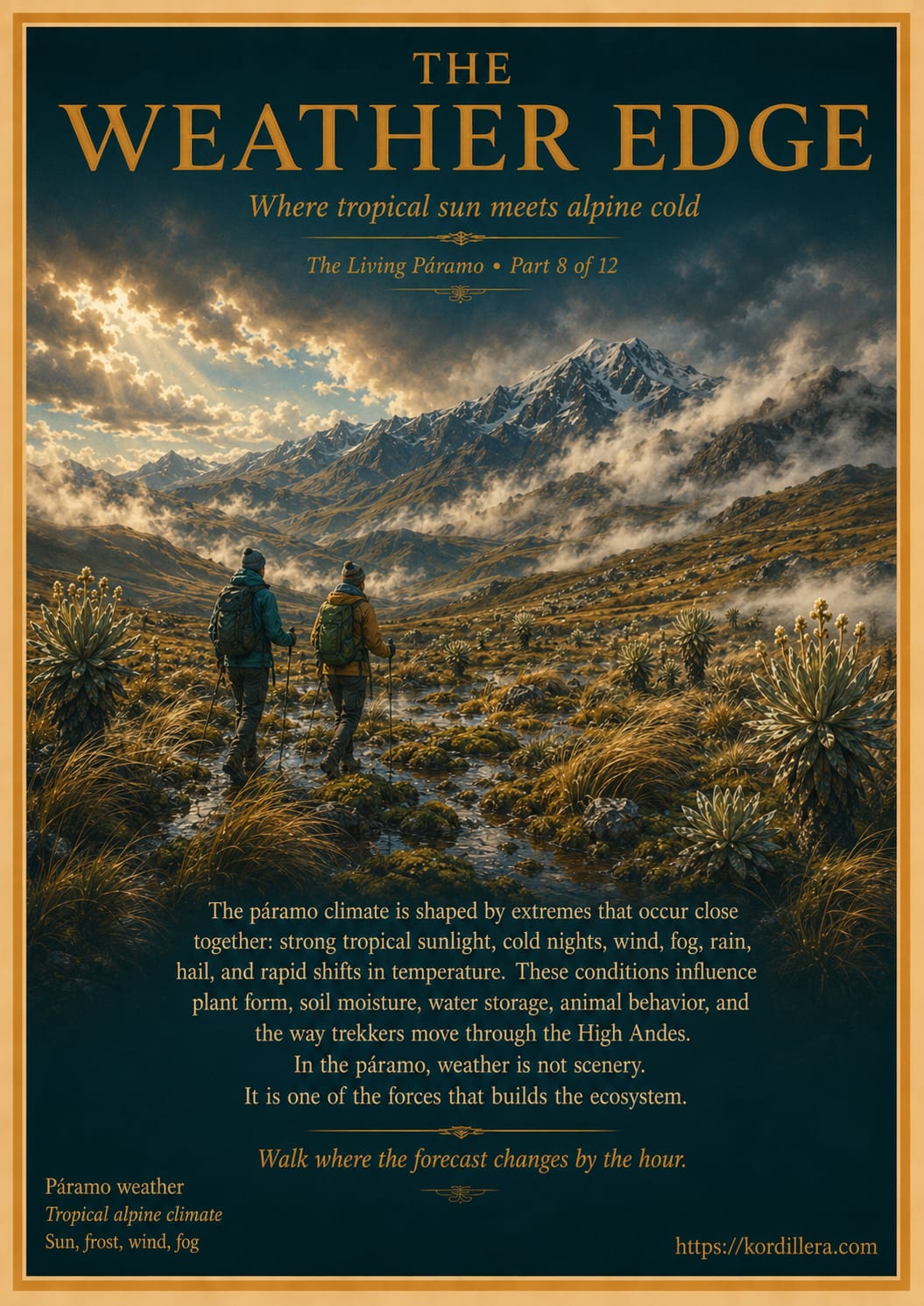
In the High Andes, we often think of “weather” as the backdrop of our adventure. We hope for clear skies, we prepare for rain, and we adapt when the forecast shifts. But in the páramo, the weather isn’t just the backdrop—it is the primary force that constructs the landscape itself.
Welcome to Part 8 of our Living Páramo series. Today, we stand on the Weather Edge.
The Tropical Alpine Paradox
The páramo exists in an unusual climatic position. It is a tropical alpine ecosystem, a paradox of geography that defines its daily reality. Located in the tropics, the páramo receives intense solar radiation, but because it sits at such high elevations, it is subject to a constant collision of forces.
Here, the environment is defined by rapid, often violent shifts. The day-to-night temperature contrast is extreme; the same ground that bakes under the tropical sun by midday may be covered in frost or hail by midnight.
This isn’t merely “bad weather.” It is a biological necessity.
Defining the Ecosystem
These volatile conditions are the architects of the páramo. Every element of the landscape is shaped by the weather:
- Plant Architecture: The unique forms of the frailejones and cushion plants are direct responses to the wind, the cold, and the necessity of thermal regulation.
- Hydrology: The consistent cycle of fog, rain, and rapid drying is what fuels the water storage capacity of the soils we explored in our last post.
- The Soil Cycle: Because of the constant shift between freezing and thawing, organic matter is preserved in a way that wouldn’t be possible in a consistent, warmer climate.
The páramo is a living, breathing system of constant interaction between tropical sun and alpine cold.
For the Trekker: Reading the Edge
For those of us moving through the High Andes, the weather is the defining experience of the landscape. In the páramo, a clear morning can dissolve into fog, gale-force wind, driving rain, and brilliant sunshine all within a single hour—or even a single mile of trail.
To trek in the páramo is to learn to read the climate as part of the landscape:
- Read the Clouds: Understand the patterns that precede the rapid shifts in moisture.
- Respect the Exposure: When the weather turns, it turns the entire ecosystem. Your clothing, your pace, and your hydration strategy must adapt to the shifting “edge.”
- Observe the Change: Don’t just endure the weather; observe how it dictates the ground moisture, the visibility, and the movement of the wildlife around you.
In the páramo, the forecast is always “change.” When you stand on the Weather Edge, you aren’t just an observer of the elements—you are a participant in the complex, daily cycle that keeps the High Andes alive.
Walk where the forecast changes by the hour.
#WeatherEdge #ParamoWeather #PáramoWeather #Paramo #Páramo #LivingParamo #HighAndes #Andes #TropicalAlpine #MountainWeather #AlpineClimate #Fog #Wind #Frost #MountainEcology #PáramoEcology #Biodiversity #Ecology #NaturalHistory #ScienceCommunication #OutdoorEducation #ExpeditionTravel #NatureTravel #AndeanNature #Conservation #KordilleraKnowledgeBase #ExploreTheAndes #WildAndes #Kordillera