The Living Páramo: Catching Clouds in the Frailejón Forest
In the vast, wind-swept expanse of the high páramo, you may encounter a forest that defies expectations. These are not the tall, wooden canopy forests of the lowlands, but an open, striking assembly of Espeletia—better known as the frailejón.
Welcome to Part 3 of our Living Páramo series. Today, we leave the open grasslands behind to walk through the plants that catch clouds.
The Architecture of Survival
The frailejón is more than just a plant; it is a masterclass in high-altitude engineering. Especially prevalent in the northern Andes of Colombia, Venezuela, and northern Ecuador, these plants have evolved a structural blueprint that allows them to thrive in environments that would be hostile to most life.
Observe a frailejón up close, and you will notice a distinct, elegant design:
- The Rosette Form: By arranging their leaves in a tight, circular pattern, they funnel moisture toward the stem while protecting the growing tip.
- Woolly Leaves: Those iconic, fuzzy surfaces are not merely for aesthetics. They serve as a protective layer, providing insulation against freezing nocturnal temperatures and a shield against the intense solar radiation found at high elevations.
In the páramo, shape is destiny. Every curve and hair on the leaf serves a purpose in managing the extreme contrast between day and night, sun and fog.
The Cloud Harvesters
In our first post, we defined the páramo as a “living sponge.” If the soil is the sponge, the frailejones are the harvesters.
Because these plants grow within the high-moisture zone of the Andes, they act as active participants in the regional water cycle. Their broad, complex surface areas intercept passing fog and rain, effectively “combing” the clouds to drip moisture down into the water-retentive soils beneath them. They are a critical piece of the Andean water infrastructure, capturing moisture that eventually sustains the rivers and streams of the valleys far below.
Changing Your Perspective on the Trail
For many trekkers, the páramo is simply a landscape to pass through. From a distance, it can look like an undifferentiated sea of grass.
However, when you enter a frailejón forest, the scale of the ecosystem shifts. The terrain is no longer “empty” ground—it is a structured, sophisticated alpine ecosystem. You are walking through an active biological system where plants are doing the heavy lifting of hydration and thermal regulation.
Next time you trek through a grove of frailejones, take a moment to look at the leaves. You aren’t just looking at flora; you are looking at one of the Andes’ most effective cloud-harvesting technologies.
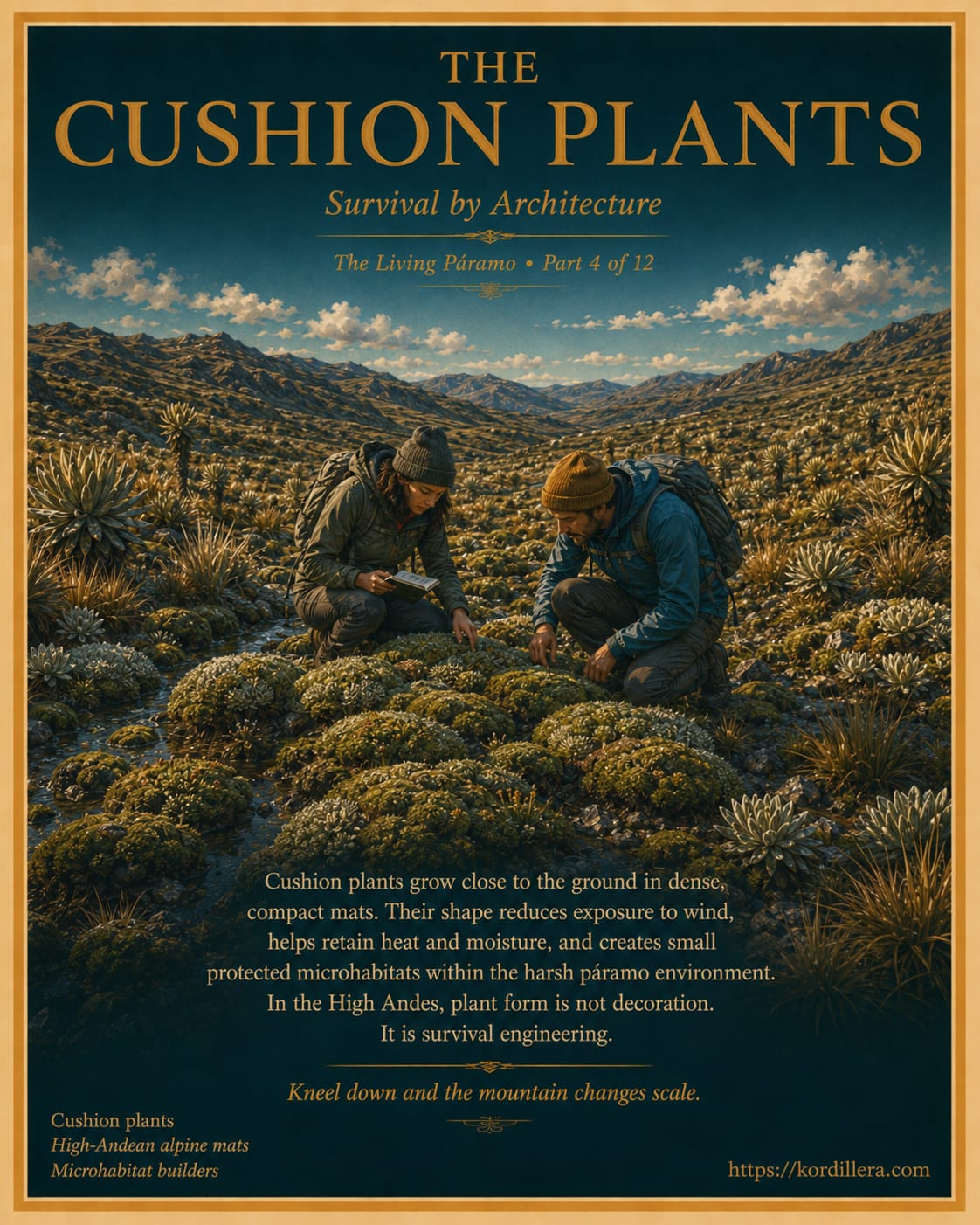
Stay tuned for Part 4, where we will move from the giants of the páramo to the miniature world of cushion plants.
#Frailejon #Frailejones #Espeletia #Paramo #Páramo #LivingParamo #HighAndes #Andes #NorthernAndes #Colombia #Ecuador #Venezuela #TropicalAlpine #HighAndeanPlants #AndeanFlora #CloudHarvesting #MountainHydrology #WaterTowers #PáramoEcology #MountainEcology #Biodiversity #Ecology #NaturalHistory #ScienceCommunication #OutdoorEducation #ExpeditionTravel #NatureTravel #AndeanNature #Conservation #KordilleraKnowledgeBase #ExploreTheAndes #WildAndes #Kordillera